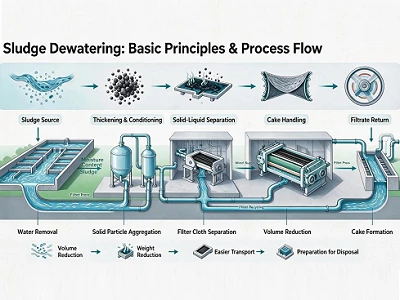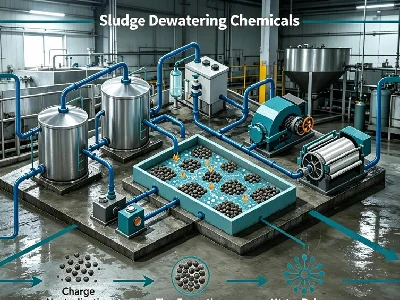
1. Coagulation stage: This involves injecting the chemical solution into the coagulation tank and rapidly mixing it with raw water to form micro-flocs within a very short time. The water becomes more turbid during this phase, which requires intense turbulence [14]. In beaker tests, rapid stirring (250–300 rpm) for 10–30 seconds-and generally no more than 2 minutes-is recommended.
2. Flocculation stage: This is the process where micro-flocs grow and aggregate into larger flocs. It requires an appropriate level of turbulence and sufficient residence time (10–15 minutes). In the later stages, large clusters of flocs can be observed settling slowly, leaving a clear water layer at the top. In beaker tests, stir first at 150 rpm for about 6 minutes, then at 60 rpm for about 4 minutes until the flocs remain in suspension.
3. Sedimentation stage: This is the process where flocs settle in the sedimentation tank; slow water flow is required. To improve efficiency, inclined-tube (or inclined-plate) sedimentation tanks are typically used (air flotation is the preferred method for floc separation). Large, coarse flocs are intercepted by the inclined tubes (or plates) and settle to the bottom, while the upper layer becomes clear water. Remaining smaller, less dense flocs continue to collide and aggregate as they slowly descend, eventually reaching a point where residual turbidity stabilizes. In beaker tests, slow stirring at 20–30 rpm for 5 minutes, followed by 10 minutes of static settling, is recommended before measuring residual turbidity.
4. Enhanced filtration: This primarily involves the proper selection of filter media structures and filter aids to increase the removal rate of the filtration unit; it is a crucial measure for improving water quality.
5. Application in environmental protection and industrial wastewater treatment: The usage method is largely the same as that in water treatment plants. It is highly effective when supplemented with additives for treating raw water with high chroma, COD, and BOD levels.
6. Enterprises currently using chemical coagulation methods do not need major equipment modifications; simply adding a dissolution tank allows for the use of this product.
7. This product must be stored in a dry, moisture-proof, and cool place away from heat sources.
8. This product must be dissolved before use; dissolution equipment and dosing facilities should be constructed from corrosion-resistant materials.